
Founded in 2007 – It’s Nice That – is a publishing platform that encompasses several on-line, print and events offerings as part of a continuing mission to champion creativity across the art & design world.
To appear as a featured artists alongside heavyweights such as ‘Design by St’ and ‘The Times’ was a massive thrill. As was having my work discussed on their fortnightly Studio Audience podcast.
FORGOTTEN FORTRESS #1
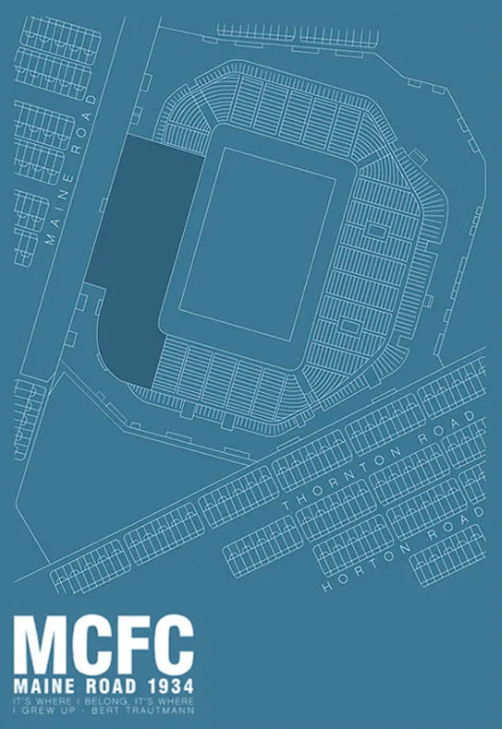
It’s where i grew up.”
– Bert Trautman
I chose Maine Road as my starting point for no other reason than i found it aesthetically pleasing.
I chose Maine Road as my starting point for no other reason than i found it aesthetically pleasing.
However, I soon ended up in a conversation with acclaimed MCFC historian and writer Gary James and was surprised to hear that I’d struck gold with my chosen layout.
Gary also unearthed a wonderful quote from City legend Bert Trautmann (bottom left of the print) which reads: “It’s Where I Belong. It’s Where I Grew Up”
GARY JAMES TRANSCRIPT
“That’s a very important layout of Maine Rd. It is accurate for 1934 & shows the corner Platt Lane roof on plan. In 1935 the rest of Platt Lane was roofed, so the ground was only like that between 1931-35. This is exactly as it was when an 84,569 attended Citys record crowd game in March 1934. You’ve picked the right plan/year.
When I researched and wrote Farewell To Maine Road (Pubd 2003) I spent quite some time trying to piece together the various ground developments. Prior to that book most articles, books, MCFC official histories claimed that the old Platt Lane Stand was built at some point ‘before the second world war’.
Using photos and then plans from Manchester Town Hall, I uncovered that the main developments in the first 20 years were:
1923 – Main Stand built and roofed
1931 – Platt Lane / Main Stand corner re-profiled to have a higher rake, seating installed on part of the new profiled steps, a higher tunnel wall (anyone who remembers Platt Lane will remember that the corner tunnel and corner terracing were different to the rest of the ground/stand), a new roof, and a ladies toilet (quite a big deal in 1931). Capacity must have been approx 85,000
1935 – The rest of the Platt Lane Stand was built by extending out the back on a wooden frame and then roofing rest of stand. Capacity was increased to about 88,000.
The plan was then to roof the Main Stand/Scoreboard (North) Stand corner in 1939, roof the North Stand c. 1944 and then tackle the Kippax c.1950 (by enlarging it – aim was for Maine Road to hold over 100,000!).
Those plans never happened because of WW2 and when peace resumed chance of improving Maine Road disappeared until the Kippax was extended (slightly) and roofed in 1957.
Capacity had reduced by that point because of legislation following Bolton disaster (another forgotten disaster sadly) – so much has been made of football not learning from Hillsborough but football also didn’t learn from Burnden Park disaster or Ibrox….“
FORGOTTEN FORTRESS #2
– Danny Blanchflower
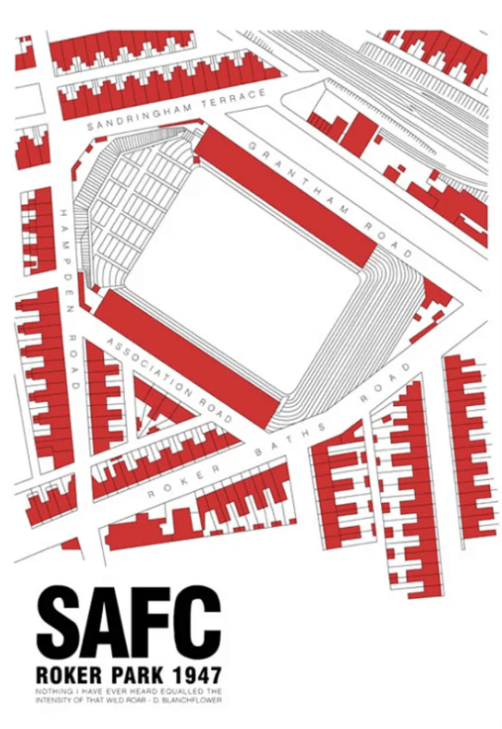
As a Middlesbrough fan I had to think long and hard before creating this particular piece.
However, I felt excluding it would contradict the aim of the project, which is to set aside personal loyalties and instead celebrate what certain grounds mean to people (both home and away).
With this is mind I was very grateful to IBWM‘s Jeff Livingstone, who offered to write an impassioned (albeit through gritted NUFC teeth) introduction to this particular piece.
JEFF LIVINGSTONE TRANSCRIPT
For almost a century, Roker Park was home to Sunderland Association Football Club. A buoyant footballing fireside situated in a housing estate, the famous ground was the pulsating heart of an industrious community.
Opened on 10 September, 1898, the stadium was constructed to house the rapidly swelling brotherhood of the 19th century ‘Team of all talents’ – a phrase coined by the founder of the English Football League, William McGregor.
McGregor’s quote was fitting:
Sunderland – with the free-scoring Johnny Campbell the figurehead of an outstanding team – were a potent force in English football in the 1890’s, contesting dominance of the league with Aston Villa for the decade.
During this period, The Groves Field in Ashbrook, Horatio Street in Roker, The Abbs Field in Fulwell and Newcastle Road in Sunderland had all been home to the club before Roker Park became the long term venue of choice.
With matchday attendances continuing to increase in the years prior to The Great War, Roker Park was redeveloped significantly in 1913 under the guidance of Archibald Leitch, the UK’s most renowned stadium architect. Contracting Leitch was not cheap, and despite raising the capacity to 50,000, the costs of redevelopment work almost bankrupt the club.
A financial collapse was not the only issue to confront the stadium during its life. In 1943 a Luftwaffe raid on the Wearside shipyards, a vital artery in Britain’s war effort, saw an errant bomb detonate on impact with the hallowed turf at Roker. The resultant explosion destroyed a corner of the ground and killed a patrolling police constable.
In the years following the war, Roker Park remained one of the most abundantly attended sporting venues in the UK, with audiences regularly topping 50/60k. The high figures were often at odds with the team’s performances, but were never in advance of the tightly packed 75,118 which witnessed an FA Cup sixth round replay against Derby County in 1933.
The recommendations of the Taylor Report in 1990 sounded a death knell for a proud ground now dowdy and downtrodden. With redevelopment prohibitively expensive and redesign ambitions curtailed by location, a choice was made by then chairman Bob Murray to move.
In May 1997, Sunderland played a lachrymose final match at Roker Park (a 3-0 victory over Everton) before decamping to the newly erected Stadium of Light at Monkwearmouth.
Steve’s use of a vivid red against a white background is not only a reflection of Sunderland’s celebrated plumage, but also a perfect representation of the area featured. As a kid, I can recall being struck by the red of the houses in the streets that surrounded Roker Park; the cloaking white fret that often rolled in from the North Sea made the brickwork appear more scarlet than other buildings in the region. It was entirely appropriate and, to a young football fan, looked most intentional. This was clearly a red and white town.
Roker Park is now extinct and a famous piece of football’s divine fabric has departed, but it is as synonymous with Sunderland as Charlie Hurley, Raich Carter and Jim Montgomery. If Sunderland is your passion, Steve’s arcadian artwork preserves the honour of a hubristic abode.
FORGOTTEN FORTRESS #3
– Herbert Chapman
Having launched the series with Maine Road and having had some favourable press from Umbro and When Saturday Comes.
It led to an overwhelming demand (from Gooners unsurprisingly) to add Highbury to the roster too.
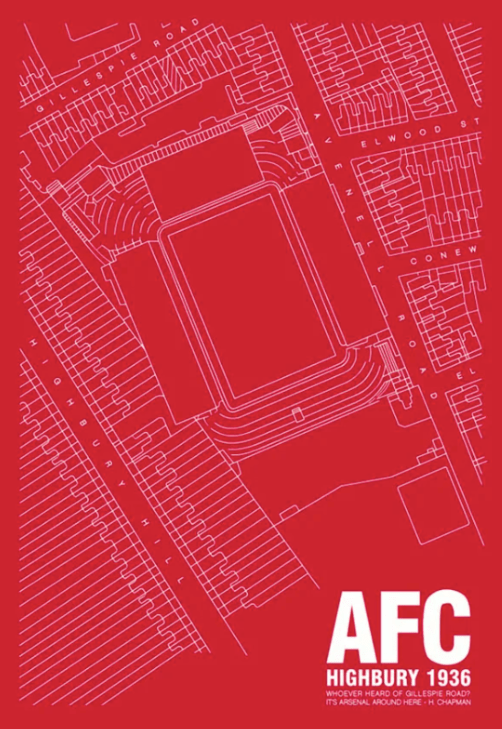
The quote shown (in the bottom right-hand corner) is that of Herbert Chapman, who, during his quest to change the name of Gillespie Road Tube Station to Arsenal, famously said:
“Whoever heard of Gillespie Road…? It’s Arsenal around here.”
Chapman is credited with introducing the WM formation, which forms the core of most modern-day formations), the use of physiotherapists, floodlighting and numbered shirts. As such he has received many posthumous honours in recognition.
The date shown on this print (1936), for those that are interested… coincides with the erection of the North Bank roof.


 The portfolio of Steve Welsh
Leave a comment