
Third party workshops and building consensus
Client:
Department for
Work & Pensions (DWP)
Area:
Health & Disability
Role:
Senior Service Designer
The problem
A previous workshop had already been championed and kicked off by the Lead Service Designer in this area. However, her subsequent exit from the team and a lack of resource within the SD community, meant I was given the opportunity to create and run the remaining sessions myself.
It included 13-16 attendees, made up of stakeholders from across a wide range of national charities. With job roles ranging from: CEO, Welfare Rights Adviser, Policy Manager, Policy Officer, Legal Rights Adviser to Policy Researcher.
The aim of the group had been to gather and share key insights within the Personal Independence Payment (PIP) end-to-end service, and to potentially inform future designs, inline with existing DWP strategic objectives.
So far 3 key citizen needs had been recognised:
- “I need to fully understand what you tell me so that I can decide what to do next”
- “I need to feel DWP care about me and want to understand my individual circumstances”
- “I need to know help is available and how to access it”
The ideas most favoured to address these needs were:
- A potential user portal
- An advertising campaign (to raise benefit awareness)
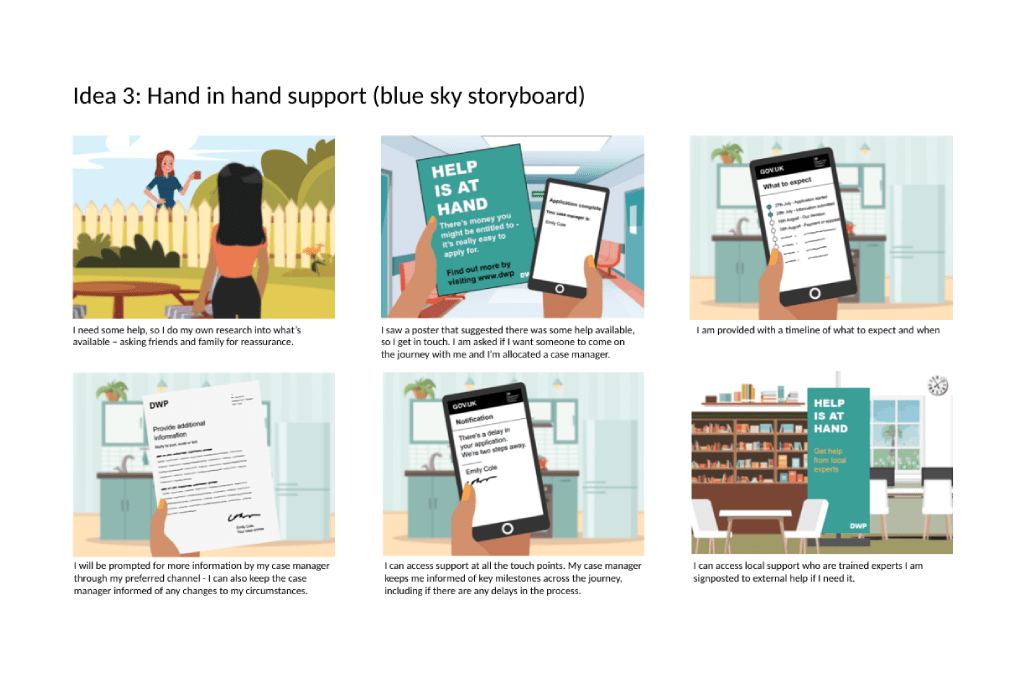
- Hand in hand support (at every stage of the journey)
Hand in hand support was identified as the most realistic direction of travel. But there was no detailed plan as to how this would be addressed, or what the scope of it would be.
What did I do about it?
Having done my own desktop research into what had gone before, it soon became apparent that scope and expectations would need to be managed carefully.
The group were naturally excited about being involved in the future direction of a service. However, they were also understandably keen to know when they would be able to see the results of the ‘blue sky’ thinking that had taken place so far.
To address this, I ran some early sessions which focused on agile ways of working, the pace of change within government services, and how we might focus on tangible outputs and outcomes whilst still moving towards aspirational longer term goals.
The focus remained on ‘how might we’ but I ensured we also had a healthy dose of:
- What might that look like?
- Who might need to be involved?
- Is anything like this already being looked at?
- How realistic is this?
How did I go about this?
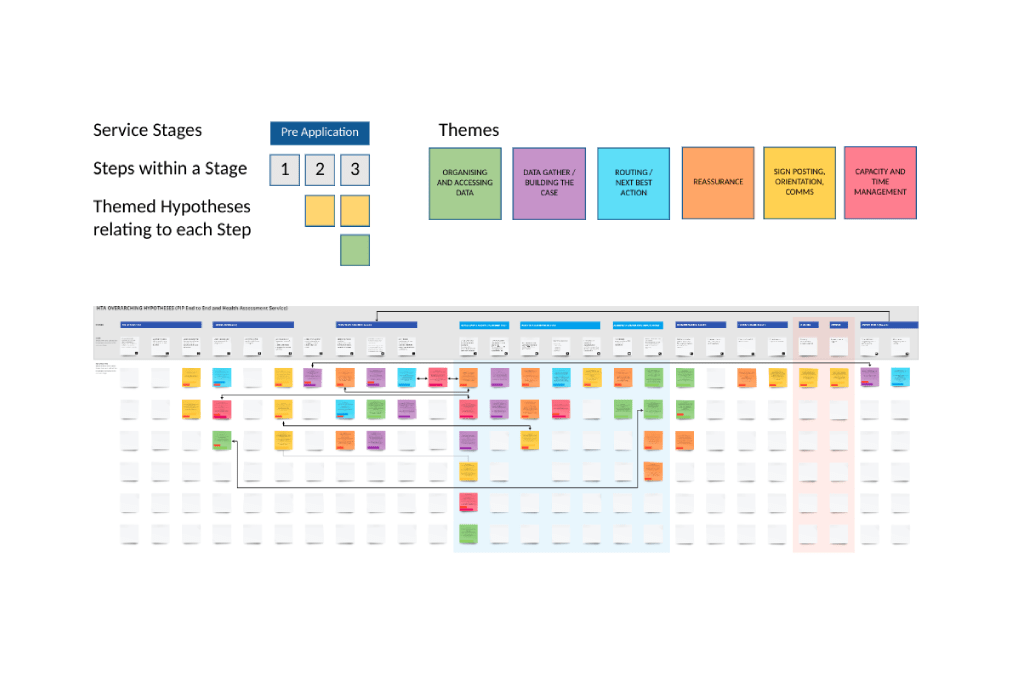
I started by mapping out the end to end process of a PIP application, paying particular attention to the point at which a health assessment may be required and what additional demands this would place on a citizen and the service.
For each step within the journey, we imported the existing team hypotheses for those areas, before colour coding them from a set of 6 primary themes
The themes in question were:
- Organising and Accessing Data
- Data Gathering / Building the Case
- Routing / Next Best Action
- Reassurance
- Signposting, Orientation and Comms
- Capacity and time Managment
The group were primarily interested in the theme of ‘reassurance’, since it was most closely related to their ‘hand-in-hand support’ north star. But what i was keen to show them, was how often that particular concept bled into the other themes too.
For each hypothesis, we listed out the pain points from UR, plus any perceived friction from the groups own perspective. We then synthesised until we had groupings that focused more on problems to be solved rather than the broader brush strokes of something like “citizens need help when filling in forms”.
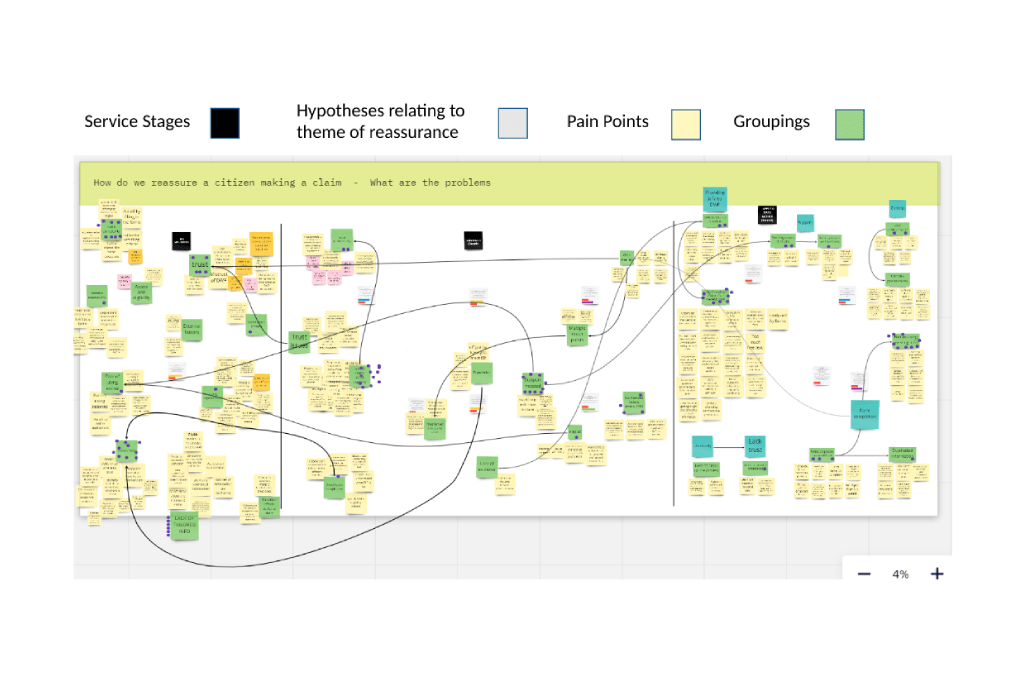
Having loosely identified our problem areas, I ran some ‘How Might We’ sessions to reframe things. As before, I wanted the group to focus on actionable ideas and the relative usefulness of those suggestions.
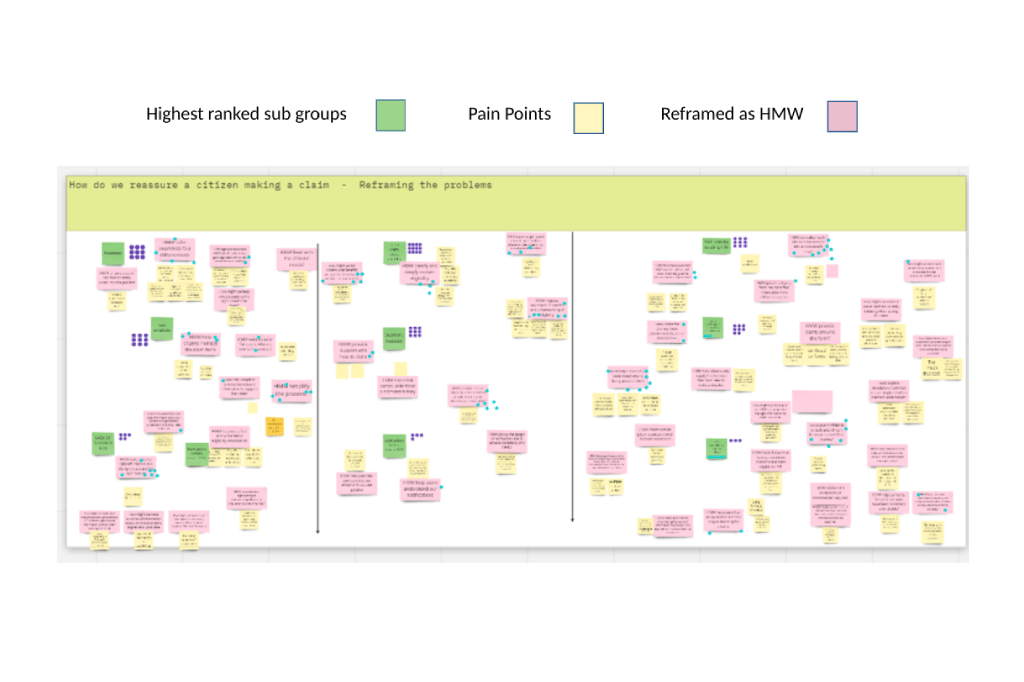
We then took the highest ranked ‘How Might We’ suggestions and broke these down even further, asking ‘how might we’ questions of the original ‘how might we’ statements.
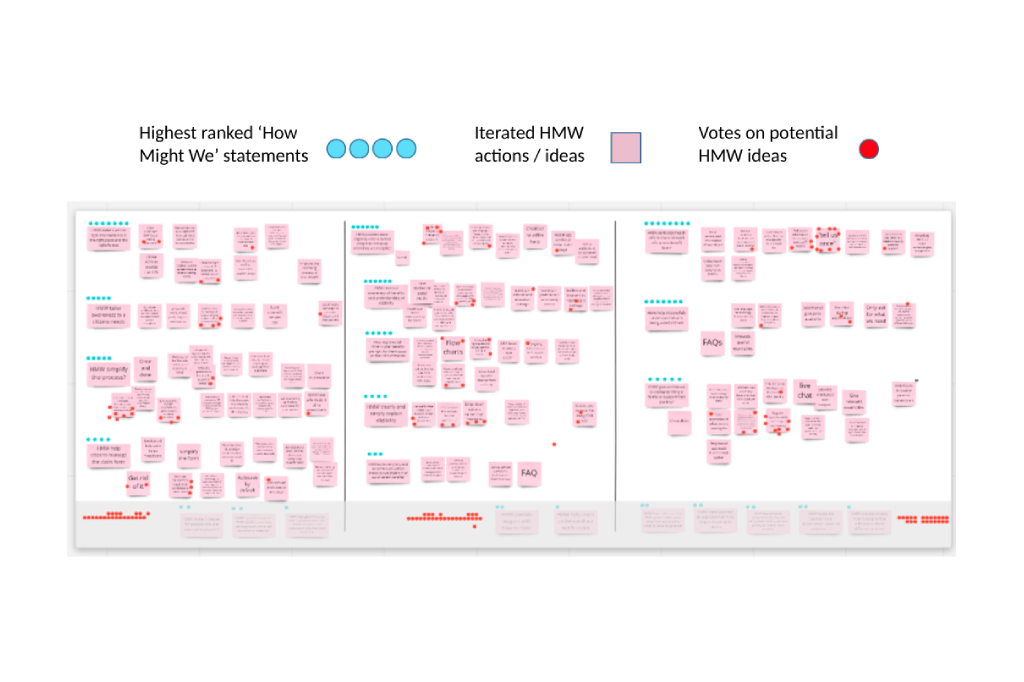
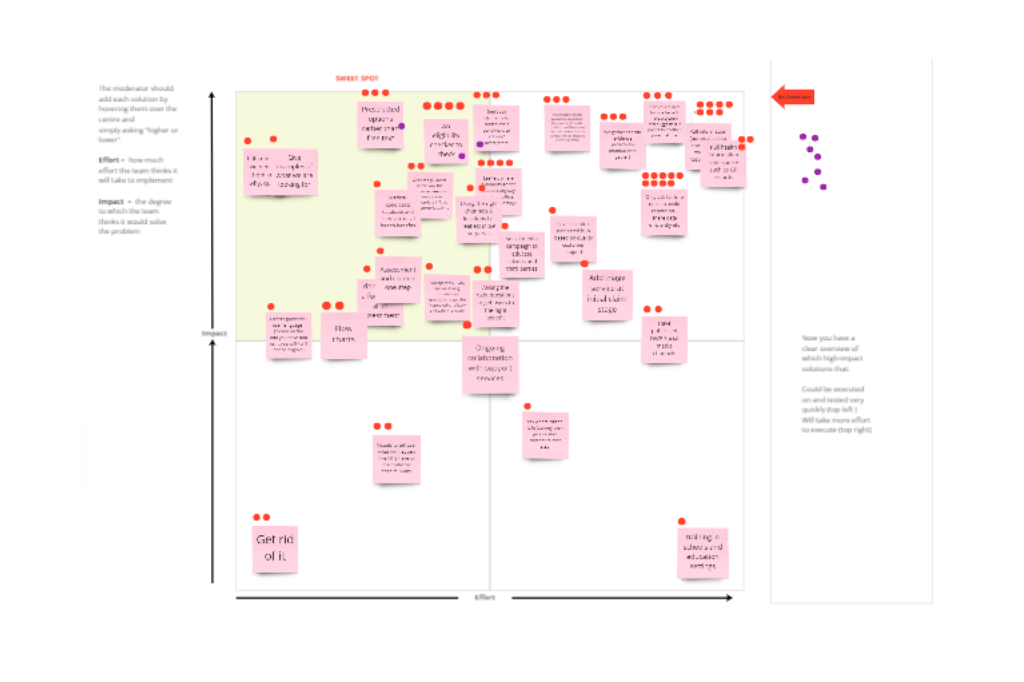
The highest ranked suggestions were then placed in an effort vs impact matrix, with the sweet spot defined as maximum impact plus minimal effort.
The group were then asked to dot vote (purple) their favourite HMW’s which sat within that sweet spot.
At this point, the majority of people thought this was the end of the workshop, and had assumed they were voting for their favoured ‘solution’, when in fact there was one crucial stage still to come.
I introduced the following swim lanes to the group, and asked them to relocate all of the HMWs from our matrix to the areas that made most sense to them.
- Service Design
- Tech Spikes
- Capabilities (to be sized)
- User Research Required (unknowns)
- Content Design
- Discovery Candidates
I also asked that any voting cast previously (including the purple dots) remained intact:
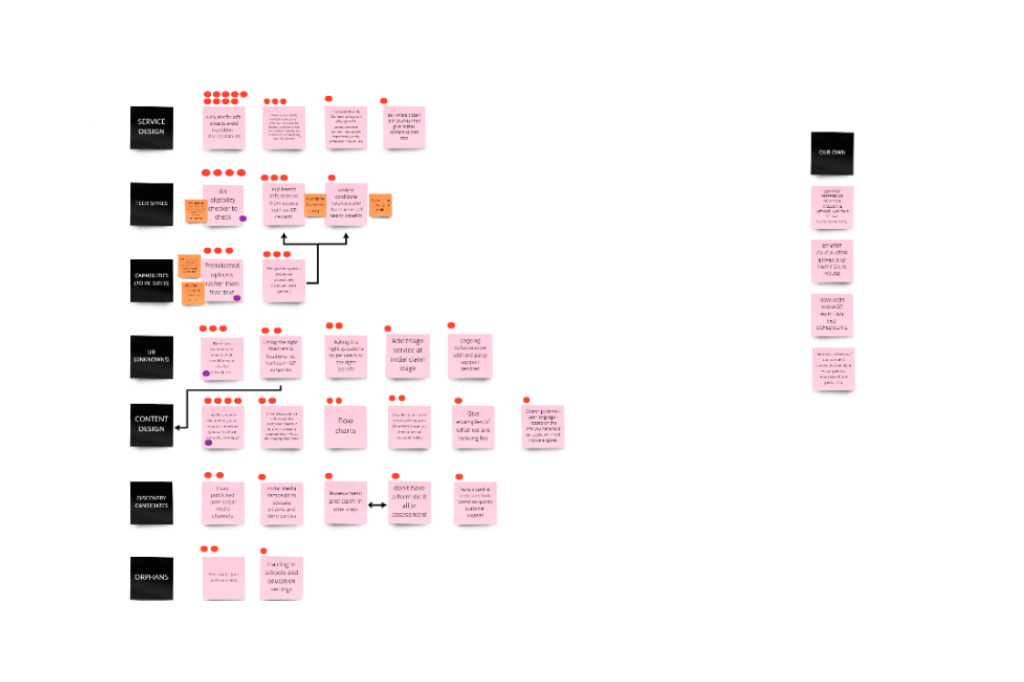
By segmenting our ideas in this way, we could suggest which areas could be worked on simultaneously or independently of other disciplines. Plus with the dot voting still intact, the prioritisation of that work had already established.
So instead of converging on a single ‘solution’, we could now justifiably run multiple experiments or investigations in parallel.
From my own experience, I’ve always found multidisciplinary teams to be at their most productive when they are allowed to flex, since not everyone within a team needs to work on every idea simultaneously.
next steps / outcomes
We finally converged on the idea of an ‘interactions log’, which would trigger specific support at key points within a citizens journey. This was of particular interest to the group as it dovetailed nicely with their idea of ‘hand in hand support’.
Having taken the group through this process, what I found most pleasing was the focus was no longer on “when will this log be ready?” instead it was provoking questions such as:
- which interactions are already captured?
- what kind of support could that trigger?
- how useful would that be to a citizen?
- is any of this feasible?
As this was the final workshop in the series, I handed back to the acting Deputy Director, who was looking to develop our relationships with 3rd party stakeholders further. Specifically their appetite to be involved with agile sprints and how this could be accommodated on both sides.
This workshop was seen as a critical step in not only strengthening those relationships but improving third party stakeholders understanding of our processes, problem spaces and ways of working.


 The portfolio of Steve Welsh